


Custom Website vs. Template Platform: Which Is Right for Your Business?
 "Custom Website vs. Template Platform: Which Is Right for Your Business?")
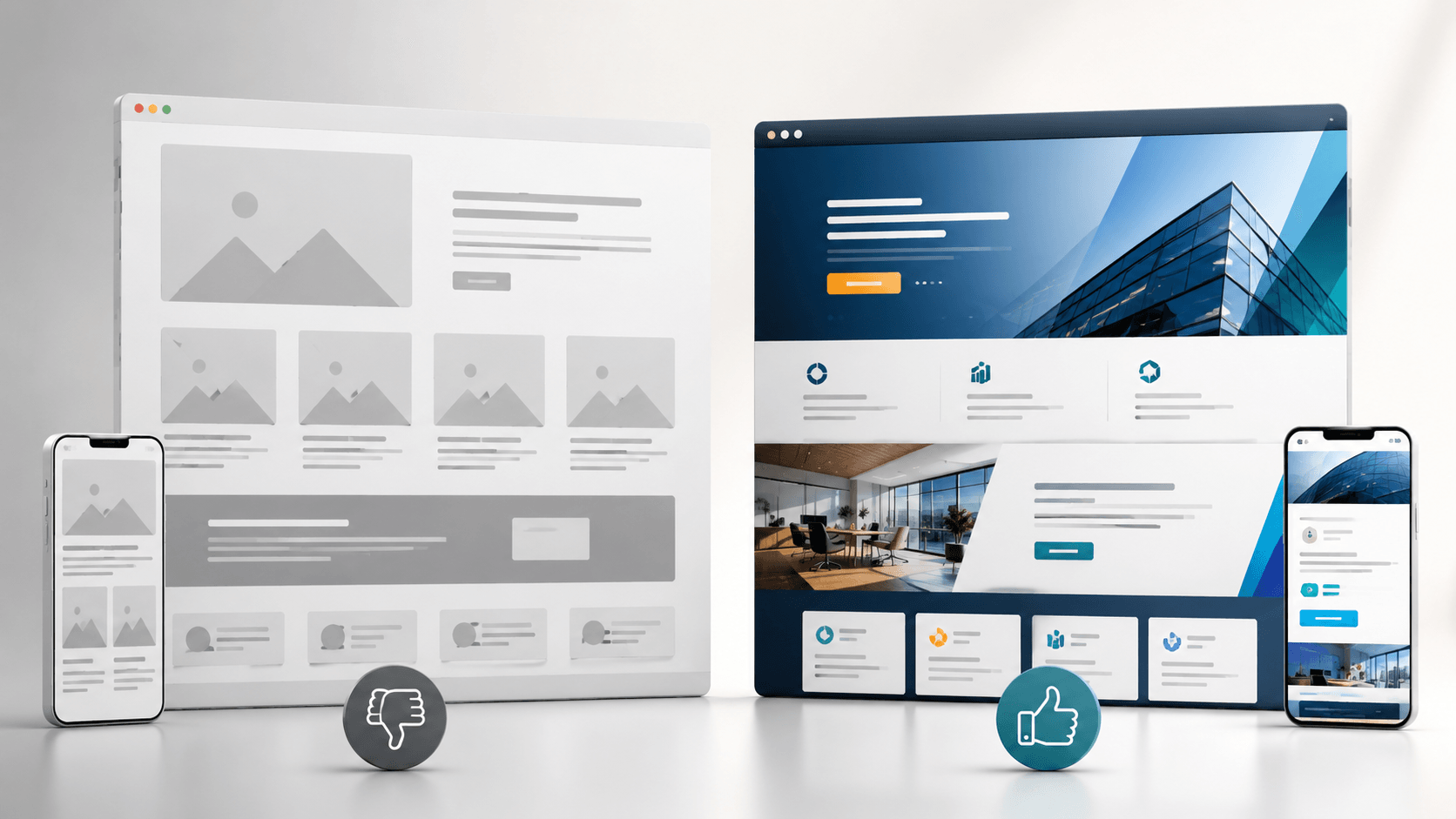
Should my business choose a custom website or a template? A template may be suitable when speed, simplicity and a limited budget are the main priorities. A custom-designed website is often a better fit when the business needs a distinctive brand experience, strategic content structure and room to grow. Fully custom-coded development is generally most appropriate when specialized functionality cannot be delivered effectively through an established platform.
The decision is often presented as a simple choice:
- Custom websites are unique and expensive.
- Templates are generic and affordable.
The reality is more nuanced.
“Custom website” can describe several very different types of projects. It might mean a professionally designed website created specifically for one business but built on a supported content management platform. It could also mean a completely custom-coded software system developed from the ground up.
Similarly, a template website might be a basic do-it-yourself design with minimal changes or a heavily customized theme implemented by an experienced designer.
The right choice depends less on the label and more on what the business needs the website to accomplish.
First, Understand the Different Website Options
Before comparing custom websites with templates, define what each option actually means.
What Is a Template-Based Website?
A template is a pre-designed layout or theme that can be populated with a company’s text, images, colours and logo.
Template-based website builders can make it possible to launch quickly without designing every component from the beginning.
Depending on the platform and implementation, a template website may offer:
- Pre-built page layouts
- Standard navigation
- Responsive design
- Basic forms
- Blogging
- Ecommerce
- Third-party integrations
- Content management tools
Templates vary considerably in quality. Some are well-designed, accessible and flexible. Others contain unnecessary features, outdated code or rigid layouts.
The result depends on the template, the platform and the person configuring it.
What Is a Custom-Designed Website?
A custom-designed website has a visual identity and page experience created specifically for the business.
Its layout, content structure, imagery, calls to action and responsive behaviour are developed around the company’s:
- Brand
- Customers
- Services
- Marketing goals
- Content
- Conversion paths
A custom-designed website does not necessarily require every line of software to be written from scratch.
It can be built on a supported platform or CMS that already provides content editing, security, forms and other common functionality. This approach combines a distinctive design with established technology.
Bloomtools websites follow this model: the design is created for the individual business, while the underlying Bloomtools platform supplies website management and integrated business tools.
What Is a Fully Custom-Coded Website?
A fully custom-coded website or web application is engineered specifically for the organization’s requirements.
This may involve custom:
- Databases
- User accounts
- Portals
- Business logic
- Workflows
- Integrations
- Search systems
- Product configurators
- Booking processes
- Reporting tools
Fully custom development can provide extensive control. It also requires more planning, testing, documentation, maintenance and specialist expertise.
Many standard business websites do not need this level of development.
Why Custom Became Synonymous With Better
Earlier template systems were often rigid and easy to recognize. They offered limited control over layout, mobile presentation and functionality.
Custom development was frequently the only way to create a distinctive experience or support specialized requirements.
Modern platforms have narrowed that gap. Many now support responsive layouts, content management, ecommerce and third-party integrations.
However, that does not mean custom design has lost its value.
Templates can provide a framework, but they are not developed around your particular customers, content or conversion goals. A custom design can create a more deliberate relationship between your brand, message and website experience.
The question is not whether one category is always better. It is whether the chosen approach supports the business effectively.
What Does Your Business Need the Website to Do?
Before comparing platforms, define the website’s role.
A growing business might need its website to:
- Explain its services
- Attract search traffic
- Generate enquiries
- Support Google Ads
- Build trust
- Publish articles
- Display case studies
- Schedule appointments
- Sell products
- Manage memberships
- Collect payments
- Integrate with a CRM
- Support email marketing
- Serve multiple locations
- Provide customer resources
Prioritize the outcomes that matter.
A template selected primarily because it looks attractive may not support the required content or customer journey. Conversely, a fully custom-coded project may introduce unnecessary cost when an established platform already provides the required capabilities.
When a Template Website May Be Appropriate
A template can be a practical choice for a new or small business with straightforward requirements.
It may be suitable when:
- The budget is limited
- A website must launch quickly
- The content is simple
- The business needs only a few standard pages
- The brand is still being validated
- No specialized functionality is required
- The owner is comfortable managing the platform
- The website is temporary or experimental
For example, an early-stage business testing an offer may not need a substantial custom project before it understands its customers and sales process.
A template can help the company establish an initial online presence and learn what content and functionality matter.
Common Limitations of Template Websites
Templates are designed for a broad market. That generality can create trade-offs.
The Design May Not Fit the Content
Templates often work best when the business adapts its content to the available layout. This can result in important information being shortened, rearranged or omitted simply because it does not fit the design.
A website should ideally be structured around what customers need to understand—not around placeholder text and image dimensions.
The Brand May Look Similar to Other Businesses
A template can be customized with fonts, colours and images, but its underlying composition may still resemble other websites using the same theme.
This may be acceptable for some businesses. It may be limiting for companies trying to establish a distinctive or premium position.
Unused Features Can Add Complexity
Some themes include sliders, animations, page builders and scripts intended to appeal to many buyers. If those features are not required, they can increase maintenance or affect performance.
Updates Can Create Compatibility Problems
A template may depend on plugins, extensions or external applications. Each dependency needs to be maintained and tested.
This does not make plugins inherently problematic. It means someone must be responsible for updates, security and compatibility.
Structural Changes May Be Difficult
A template may be easy to edit within its intended layout but difficult to adapt beyond it. As the business grows, adding new content types or changing navigation can expose those limitations.
When Custom Design Is Worth the Investment
A custom-designed website can be valuable when the business has established services, a defined market and specific growth goals.
It may be appropriate when:
- Brand differentiation matters
- The website is a major lead source
- Several services need to be organized clearly
- The customer journey is complex
- The business serves multiple audiences
- Conversion paths require careful planning
- The company needs campaign landing pages
- Content and SEO are important
- The site must grow with the business
- A professional team will support the project
Custom design allows the website to respond to the business rather than requiring the business to adapt to a pre-selected layout.
The design process can consider:
- What visitors need to understand first
- How services should be grouped
- Which trust signals matter
- Where calls to action should appear
- How the experience changes on mobile
- How new content will be added
- How the website supports marketing
When Fully Custom Development Makes Sense
Fully custom development is justified when the required functionality cannot be delivered adequately through an established platform or existing integration.
Examples might include:
- A specialized client portal
- Proprietary quoting software
- Complex product configuration
- Unique marketplace functionality
- Industry-specific workflows
- Advanced data integrations
- Custom access and permission systems
- High-volume transactional applications
A large organization may also choose custom development when it needs complete control over infrastructure, data, software architecture and deployment.
Before committing, confirm that the requirements genuinely need custom engineering. Sometimes a proven platform or integration can solve the problem with less cost and risk.
When Fully Custom Development Becomes Overkill
For a typical small or medium-sized business website, fully custom code may add complexity without creating proportional value.
The initial development cost is only one consideration.
The business may also need to budget for:
- Ongoing development
- Security updates
- Hosting
- Monitoring
- Backups
- Bug fixes
- Documentation
- Testing
- Staff training
- Future integrations
Custom software can also create dependence on the original development team if the code is poorly documented or uses uncommon technology.
This does not mean custom development is a bad investment. It means the expected business value should justify the total cost and maintenance responsibility.
Speed to Launch vs. Long-Term Fit
Templates can usually be launched faster because the visual system and many components already exist.
Custom design requires discovery, planning, design, content preparation, development and testing. This generally takes longer, but it can produce a website more closely aligned with the business.
Speed has value when:
- A new business needs to establish credibility
- A campaign has a fixed deadline
- The company is testing an offer
- The existing website is seriously outdated
- A temporary solution is acceptable
Long-term fit may be more important when:
- The website will be a central sales tool
- Organic search is a priority
- Several services must be explained
- The brand needs differentiation
- Conversion improvements matter
- The website must support future growth
The best choice balances launch speed with the cost of limitations later.
Iteration Matters More Than Perfection
No website launches in a permanently finished state.
Customer questions change. Offers evolve. Marketing campaigns produce new information. Website data reveals what visitors use and where they encounter friction.
An effective website should make it possible to:
- Update messaging
- Create landing pages
- Add services
- Publish articles
- Refine forms
- Change calls to action
- Add proof
- Improve internal links
A theoretically perfect website that is difficult to update may become less useful than a simpler website that can be improved regularly.
However, iteration speed is not determined only by whether the site is custom or template-based. It depends on the CMS, permissions, component structure, provider support and internal processes.
Execution Quality Matters More Than the Label
A custom website can perform poorly. A template website can perform well.
The build category does not guarantee:
- Search rankings
- Accessibility
- Website speed
- Security
- Leads
- Sales
- Conversion rates
Performance depends on how well the website addresses areas such as:
- Messaging
- Content
- Information architecture
- Mobile usability
- Accessibility
- Technical SEO
- Page experience
- Calls to action
- Lead capture
- Follow-up
Web.dev recommends building websites that are accessible, fast, secure and functional across browsers. These qualities require implementation and testing regardless of the platform.
Explore web.dev’s website development guidance for more information about accessibility and performance.
Do Templates or Custom Websites Rank Better?
Google does not rank a website simply because it is custom-coded or template-based.
Search visibility depends on factors such as:
- Crawlability
- Indexability
- Helpful content
- Relevance
- Internal links
- Mobile usability
- Page experience
- Website reputation
The platform must allow the business or its marketing team to manage essential SEO elements, including:
- Page titles
- Meta descriptions
- Headings
- URLs
- Canonical tags
- Redirects
- XML sitemaps
- Image alternative text
- Structured data
A custom build with technical indexing problems can perform poorly. A template website with useful content and sound implementation can perform well.
When comparing providers, ask what SEO controls are included and who will be responsible for optimization after launch.
Compare Accessibility, Not Just Appearance
The website should work for people using different devices, browsers and assistive technologies.
Evaluate:
- Keyboard navigation
- Heading structure
- Form labels
- Alternative text
- Colour contrast
- Focus indicators
- Mobile controls
- Error messages
- Text resizing
A template marketed as accessible should still be tested after customization. New colours, content, forms and plugins can introduce issues.
Similarly, a custom design does not become accessible automatically. Accessibility must be considered during design, development and content creation.
Consider the Total Cost of Ownership
The cheapest launch price is not necessarily the lowest long-term cost.
When comparing options, consider:
- Initial design and development
- Hosting
- Software subscriptions
- Paid themes
- Plugins or applications
- Security
- Updates
- Support
- Maintenance
- Content changes
- Training
- Future development
- Redesign or migration costs
A template may have a low initial cost but require several subscriptions and ongoing troubleshooting. A custom-designed platform may cost more initially but include support and integrated functionality.
A fully custom system may provide unique value while carrying greater maintenance responsibilities.
Ask each provider for a clear explanation of included and recurring costs.
Questions to Ask Before Choosing a Website Approach
Use these questions to compare your options.
Business Requirements
- What should the website help us accomplish?
- Which customers are we trying to reach?
- How important is brand differentiation?
- How will the website generate leads or sales?
- What might change over the next several years?
Content and Marketing
- Can we create new service pages?
- Can we publish articles and case studies?
- Can we build campaign landing pages?
- Can our team update messaging?
- Which SEO controls are available?
Functionality
- Which features are included?
- Which integrations are supported?
- Will we need custom development?
- Can functionality be added later?
- How is customer data handled?
Ownership and Support
- Who owns the domain and content?
- Can website data be exported?
- Who manages security and updates?
- What support is included?
- What happens if we change providers?
Cost
- What is the launch cost?
- Which subscriptions are required?
- What maintenance is included?
- How are future changes priced?
- What is the expected total cost over several years?
The answers will be more useful than deciding according to the words “custom” or “template” alone.
Avoid Overbuilding Before Proving What Works
Growing businesses sometimes assume that increased scale requires increased technical complexity.
That is not always the case.
Before investing in specialized development, validate:
- The offer
- Customer demand
- Website messaging
- Lead sources
- Conversion paths
- Sales process
- Required functionality
Start with a foundation that meets current needs and can accommodate reasonable growth. Add custom functionality when it solves a demonstrated problem or creates measurable value.
This approach can reduce risk and make future investment more informed.
How Bloomtools Combines Custom Design With a Proven Platform
Bloomtools Canada does not require businesses to choose between a generic template and building every function from scratch.
Each Bloomtools website is custom-designed for the individual company. The visual experience, content structure and responsive layouts are developed around its brand and goals.
The website then operates on the supported Bloomtools platform, which provides content management and a range of integrated tools.
Depending on the business, these can include:
- Lead-capture forms
- Content management
- Blogging
- Landing pages
- Email marketing
- CRM and lead management
- Ecommerce
- Membership tools
- Surveys
- Testimonials
This approach provides a distinctive design while allowing the business to benefit from established functionality and centralized support.
Learn more about Bloomtools custom website design, the Bloomtools Content Management System and the complete Bloomtools Toolbox.
Choose the Website That Supports Your Business
The custom-versus-template decision should not be based on status or assumptions.
A template may be appropriate for a simple or temporary website. Custom design can create a stronger fit for an established business with specific customers and marketing goals. Fully custom development can support requirements that established platforms cannot deliver effectively.
The right website should:
- Communicate clearly
- Support the customer journey
- Represent the brand
- Generate appropriate actions
- Work across devices
- Be maintainable
- Support SEO
- Integrate with business processes
- Adapt as the company grows
The most valuable website is not automatically the most customized or the least expensive. It is the one that provides the right combination of design, functionality, flexibility and support for the business.
Contact Bloomtools Canada to discuss a custom-designed website built on a supported platform for long-term business growth.
| Tags:Business DevelopmentWebsiteWeb Development |

 "Traditional SEO vs. GEO: How to Get Your Business Recommended by ChatGPT and Gemini")
 "The Business Owner’s Guide to AI Search Optimization Costs and GEO ROI")
 "How to Choose an Agency for AI Search Optimization in Canada")
